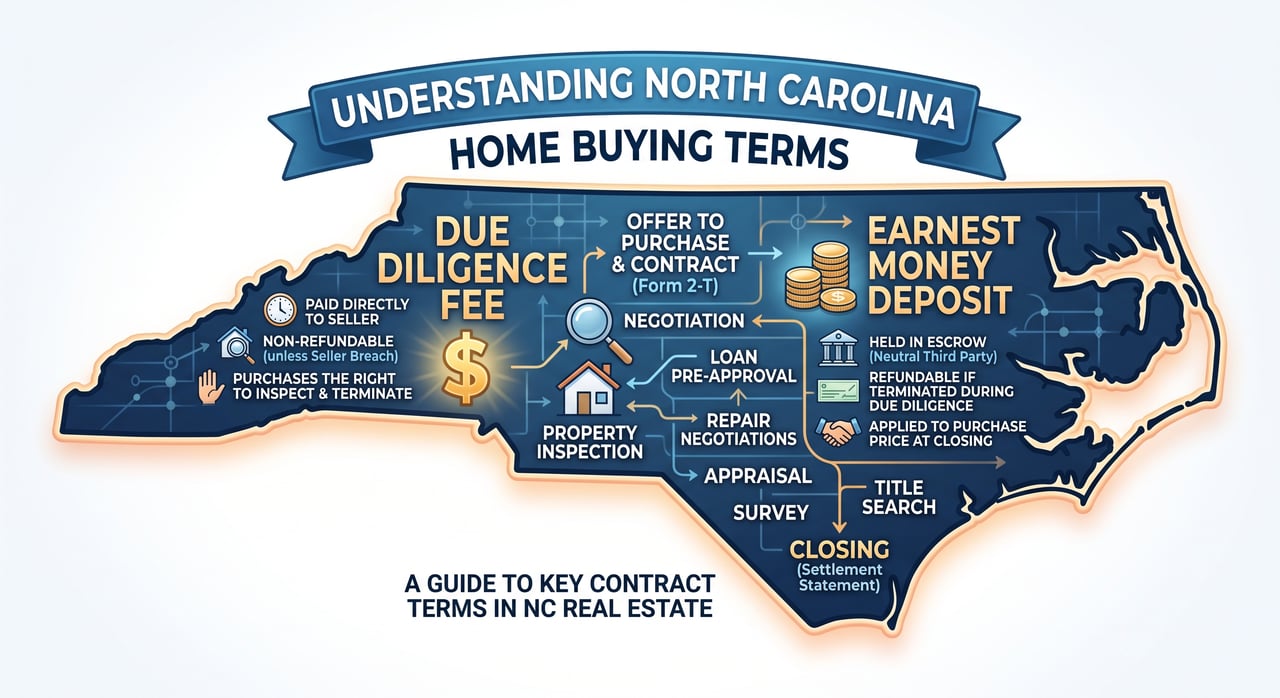
What Is the Due Diligence Fee When Buying a Home in North Carolina?
If you're relocating to the Triangle from almost anywhere else in the country, this is the term that trips people up the most. The Due diligence fee and earnest money get used interchangeably online, and they're not the same thing. Confusing them can cost you real money or worse, cost you the house.
What Exactly Is the Due Diligence Fee?
In North Carolina, the due diligence fee is a payment you make directly to the seller, not held in escrow by an attorney or title company. It's typically a non-refundable, one time payment paid directly to the Seller with narrow exceptions like seller breach or misrepresentation, and it's credited back to you at closing as part of your down payment.
Think of it as the price you pay the seller to take their home off the market to allow you access to their home. During your due diligence period, which you and your agent negotiate as part of the offer, you get to do everything: home inspections, radon, termite, well and septic checks, HOA document review, survey - whatever due diligence actually means for that specific property. If you decide to walk away for any reason before the due diligence period ends, the fee generally stays with the seller.
How Is It Different From Earnest Money?
Earnest money is the deposit your selected closing attorney holds in a trust account, and it operates under separate refund rules tied to specific contract contingencies, like financing or appraisal. Due diligence fee and earnest money are both signs of buyer commitment, but they behave completely different if a deal falls apart. I explain both any time I write an offer, because sellers read them as two different signals of how serious you are.
Why Due Diligence Amounts Look So Different Across The Triangle
This is the part a generic answer can't give you. There's no set formula for the due diligence fee - it's negotiated, and what a competitive number looks like shifts subdivision to subdivision. A well priced listing in downtown Cary or Inside the Beltline or in Apex, with multiple offers expected, often calls for a meaningfully stronger due diligence fee than the same price point in a slower moving pocket of Chapel Hill or Fuquay Varina. I look at recent closed comps and current showing activity on the specific listing before I ever recommend a number to a client, because guessing here either weakens your offer or overcommits your cash unnecessarily.
What I Tell Every Buyer Before They Write an Offer
North Carolina is a buyer beware state. Sellers and agents can't lie or hide material facts, but the responsibility for finding problems sits with you, the buyer, during due diligence. I want every client to understand that offer strength isn't just about price, it's price, due diligence fee, earnest money, financing terms, and closing timeline working together. Relocation buyers especially need this explained before they write an offer, not after they've already lost one.
Frequently Asked Questions
Is the due diligence fee refundable in North Carolina? Generally, no. It's paid directly to the seller and is non-refundable if you back out during your due diligence period, except in cases of seller breach or misrepresentation. It is credited toward your purchase price at closing if the sale goes through.
Do I need both a due diligence fee and earnest money? In most North Carolina purchase contract, yes. They serve different purposes and are held differently. The due diligence fee goes to the seller directly, and earnest money sits in an attorney's trust account under its own refund terms.
How much should my due diligence fee be? There's no fixed percentage or formula. What I typically recommend in a non-competitive situation is 1% of the purchase price. If we're in a multiple offer situation, due diligence can be one of your strongest levers and I'll recommend 3-5%, sometimes even higher. It really depends on the property, how competitive that specific listing is, and how strong you need your offer to look. I pull recent comps and current activity before recommending a number for any client's specific situation.
What happens if I find a major issue during my due diligence period? You can negotiate repairs or a price adjustment with the seller, or you can walk away entirely before your due diligence period ends. Either way, your due diligence fee generally stays with the seller as agreed in the contract.
Can I get my due diligence fee back if I change my mind for no reason? No, not usually. That's the tradeoff for taking a property off the market while you complete your inspections. It's one of the reasons due diligence strategy matters as much as your offer price.
Jody Doran is a residential real estate broker with Compass, serving buyers and sellers from Chapel Hill to Holly Springs. Have a due diligence question specific to your search? Send her a message.
